New: 1-877-751-1871
Used: 1-844-793-0754
Service: 450-692-9600

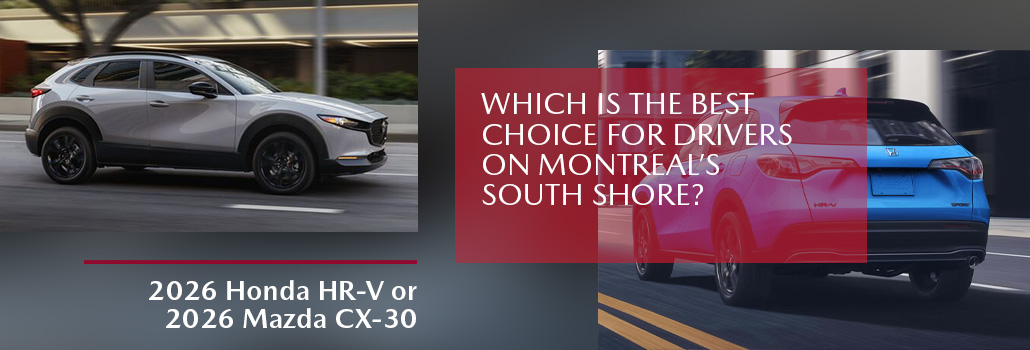
Choosing a subcompact SUV in 2026 is far from a simple decision. There are numerous models, technologies are becoming increasingly similar, and technical specs often show comparable figures. Yet, it only takes a few kilometers behind the wheel to realize that some vehicles have real personality while others prioritize simplicity above all else.
That is exactly what distinguishes the 2026 Mazda CX-30 and the 2026 Honda HR-V.
On paper, both SUVs meet the same needs. They comfortably seat five occupants, boast an excellent reputation for reliability, offer a host of advanced safety systems, and display reasonable fuel economy. Both are excellent choices for a family, a young professional, or a couple looking to replace a compact sedan.
But once on the road, their philosophies become completely different.
The Honda HR-V prioritizes comfort, smoothness, and ease of driving. It quickly inspires confidence and relies on a no-surprise experience. It is a vehicle designed to transport its occupants efficiently, without trying to impress.
The Mazda CX-30, meanwhile, is built with a much more emotional approach. From the first few meters, you can feel that Mazda’s engineers wanted to create something that feels more like a sports car than a simple urban utility vehicle. The steering is more communicative, the chassis feels stiffer, acceleration is more energetic, and the sense of control is reminiscent of certain European vehicles.
For motorists in Longueuil, Brossard, Saint-Hubert, Boucherville, Chambly, Beloeil, Sainte-Julie, Candiac, La Prairie, or Saint-Jean-sur-Richelieu, this difference quickly takes on real meaning.
Crossing the Samuel-De Champlain Bridge every morning, taking highways 10, 20, or 30, driving in November rain, or facing a snowstorm in January represents an excellent test for these two vehicles.
It is precisely in these real-world situations that this comparison takes on its full value.
The goal is not to declare an absolute winner.
The Honda HR-V possesses real qualities that it would be unfair to ignore.
The Mazda CX-30, however, has several technical arguments that explain why it appeals so much to driving enthusiasts.
Let’s now see which one really best meets the needs of Quebec drivers.
Observing both vehicles in a parking lot, one immediately understands that Mazda and Honda are not pursuing the same goal.
The HR-V inspires robustness and versatility. Its lines are sober, balanced, and discreet. Its design will likely age very well as it does not try to follow current trends.
The CX-30 instead adopts Mazda’s Kodo design language. The surfaces are sculpted, the fenders are more muscular, the play of light constantly changes depending on the angle of the sun, and the silhouette looks much more dynamic. Even when parked, it gives the impression of being in motion.
This difference continues when you open the door.
The HR-V welcomes its driver with a spacious, bright, and very functional cabin. Controls are simple to understand, visibility is excellent, and everything is designed to make daily life easier. Families will immediately appreciate this approach.
The CX-30 offers a different atmosphere.
You sit slightly lower, the dashboard wraps more around the driver, and the whole setup is almost reminiscent of a sports sedan. The materials used, the assembly, and the textures give an impression of superior quality that far exceeds what is usually found in this category.
Mazda has also worked significantly on soundproofing. The manufacturer mentions having reduced noise from the wind, tires, and the road to offer a more refined atmosphere, an element that quickly becomes noticeable during long trips on Highway 20 toward Montreal or during a weekend getaway to the Eastern Townships.
This philosophy already explains a good part of the differences between these two excellent SUVs.
The Honda HR-V seeks above all to simplify life.
The Mazda CX-30 seeks to make every trip more enjoyable.
The difference may seem subtle on paper.
It becomes very obvious as soon as the road starts to curve.
There are vehicles that perfectly fulfill their mission. They start every morning, consume little, transport their occupants comfortably, and never really ask for attention. The 2026 Honda HR-V belongs to this category. Its behavior is predictable, reassuring, and extremely easy to get used to. It is an SUV that pleases because it never tries to surprise its driver.
The 2026 Mazda CX-30 adopts a completely different philosophy.
At Mazda, engineers often talk about the Japanese concept of Jinba Ittai, an expression that evokes the perfect harmony between rider and horse. Behind this idea lies a simple goal: to ensure the vehicle reacts naturally to the driver’s intentions.
This approach may sound like marketing when read in a brochure.
It becomes very real, however, when you get behind the wheel.
From the first few meters, the CX-30’s steering feels more direct. The steering wheel requires fewer corrections on the highway and transmits more information from the road. When leaving Brossard toward Montreal via the Samuel-De Champlain Bridge, one quickly notices that the Mazda remains remarkably stable despite the gusts of wind that can blow across the river.
The Honda HR-V also inspires confidence, but its steering is lighter and more oriented towards comfort. Some drivers will appreciate this smoothness during daily urban commutes. Others will prefer the additional precision offered by the CX-30 when driving several hundred kilometers each week.
The difference becomes even more evident when the road stops being perfectly straight.
The curves leading to Bromont, Sutton, or Magog quickly allow one to understand the work done on the Mazda’s chassis. Body roll is better controlled, weight transfers are more progressive, and the whole feels solidly anchored to the road.
Mazda also includes its G-Vectoring Control Plus system as standard, a technology that subtly adjusts engine torque to improve stability and fluidity in corners. The driver does not directly feel its intervention, but they benefit from more natural handling and better precision, particularly on secondary roads or when weather conditions become more difficult.
The Honda HR-V also has excellent road holding. Its independent rear suspension helps maintain reassuring and very balanced behavior. However, Honda prioritizes comfort over dynamism. Reactions are intentionally softer to satisfy the greatest number of motorists.
This difference in personality directly influences the driving pleasure.
After an hour behind the wheel of the CX-30, you feel more like you have driven a car than an SUV.
After an hour in the HR-V, you mostly remember its ease of use.
Both approaches are excellent.
They simply don’t cater to the same drivers.
Technical specifications rarely tell the whole story.
On paper, the Honda HR-V develops 158 horsepower thanks to its 2.0-liter naturally aspirated engine paired with a continuously variable transmission (CVT). This engine is known for its smoothness, reliability, and quiet operation. It prioritizes economical and uncomplicated driving above all else.
In heavy traffic between Longueuil and downtown Montreal, this mechanics do exactly what is expected of it. Starts are progressive, acceleration is linear, and the CVT constantly maintains the engine in its optimal performance range.
For many drivers, this simplicity is precisely an advantage.
The Mazda CX-30, however, plays in another category.
All versions come standard with a 186-horsepower 2.5-liter Skyactiv-G engine, a gain of nearly 30 horsepower compared to the HR-V. This difference seems modest when looking only at the numbers.
It, however, completely transforms the sensations behind the wheel.
When you need to pass a truck on Highway 10 or accelerate to merge onto Highway 30, the CX-30 responds immediately. Pick-up is punchier, acceleration requires less effort, and the driver feels a much greater power reserve.
Mazda also retains a conventional six-speed automatic transmission rather than a CVT.
This choice contributes enormously to driving pleasure.
Gear changes provide a more natural feel, acceleration seems more progressive, and the engine responds more to the driver’s input.
Driving enthusiasts will particularly appreciate this difference.
Those who only seek a peaceful vehicle for their daily commutes might prefer the characteristic smoothness of the Honda’s CVT.
The gap becomes even more impressive when moving up to the GT Turbo or GT Kuro versions of the Mazda CX-30.
The turbocharged engine develops up to 250 horsepower and 320 lb-ft of torque with premium fuel, figures that far exceed the expectations of the category.
At this performance level, the CX-30 practically ceases to be a simple subcompact SUV.
It becomes a vehicle capable of providing real driving pleasure while retaining the practical side sought by a family or an active couple.
Honda simply does not seek to compete on this ground.
Its goal is different.
The HR-V favors proven mechanics, simple to maintain, and designed to accompany its owner for many years.
Mazda, for its part, manages to offer this same reputation for reliability while providing a much livelier driving experience.
This is probably where the philosophies of the two manufacturers differ the most.
In Quebec, a vehicle is never judged solely on a sunny day in July.
It must also be able to face a snowstorm on Highway 30, an icy road between Beloeil and Saint-Bruno, or a snowy secondary road heading to the Eastern Townships.
It is precisely in these conditions that the choice of an SUV takes on all its importance.
At first glance, both models seem well prepared. The Honda HR-V offers its Real Time AWD system with intelligent control, recognized for its ability to automatically transfer torque to the rear wheels when a loss of grip is detected. It is an effective system that intervenes quickly to improve traction on slippery roads.
For the majority of drivers, this technology perfectly meets the needs of the Quebec winter.
The Mazda CX-30, however, adopts a slightly different approach.
From the GX version, the i-Activ all-wheel drive is standard. Unlike many systems that react primarily when a wheel begins to slip, Mazda’s continuously analyzes different parameters such as outside temperature, accelerator usage, steering angle, or even vehicle movements to anticipate loss of grip.
In practice, this difference translates into a very natural feeling of stability.
When leaving Longueuil early on a January morning while the road is covered with packed snow, the CX-30 seems constantly solidly planted on the road. Electronic interventions are discreet and give the impression that the vehicle reads the road before the driver even notices a loss of traction.
This extra confidence becomes particularly appreciable when driving on less well-plowed roads in Montérégie or when taking hilly sectors near Bromont, Sutton, or Orford.
Mazda also adds another element that is often underestimated.
The G-Vectoring Control Plus control is not only used to improve sporty driving. In winter, it also helps stabilize the vehicle in directional changes by subtly modulating engine torque. The driver feels fewer abrupt movements, which promotes smoother driving when grip is limited.
The Honda HR-V nonetheless remains an excellent winter companion.
Its behavior is extremely reassuring, its ground clearance is well-suited to normal snow accumulations, and its various drive modes, including Snow mode, make travel easier when conditions deteriorate.
For many families, this simplicity is even an advantage.
The Mazda CX-30, however, provides a more refined impression.
You feel more of the chassis’ work, body movements are better controlled, and the whole inspires confidence that often exceeds what is expected from an SUV in this category.
For motorists who travel highways 10, 20, or 30 daily, this difference quickly becomes perceptible after only a few weeks.

Comfort is not just about the quality of the seats.
It is a whole made up of dozens of small details that end up making a big difference after several years of driving.
The Honda HR-V perfectly understands this reality.
As soon as you take a seat behind the wheel, the driving position feels natural. Large glass surfaces offer excellent visibility, and the cabin provides an immediate impression of space. Rear passengers also benefit from generous legroom, an element that will particularly appeal to families or drivers who regularly transport adults. The HR-V also offers a cargo volume of up to 1,559 liters when the rear seatbacks are folded, which is a real advantage for those who prioritize cargo capacity.
For a trip to Costco, a camping weekend, or a student move between Brossard and Sherbrooke, this extra space quickly becomes appreciable.
The Mazda CX-30 adopts a different approach.
The goal is not to offer the largest trunk or the most spacious cabin in the category.
Mazda seeks instead to create a high-end atmosphere.
Materials feel richer to the touch, controls offer a resistance that inspires quality, and every element seems to have been designed to reduce driver distractions.
Even the cockpit illustrates this philosophy.
The screen is positioned higher to limit eye movement, while the rotary controller for the HMI interface allows navigating through menus without having to constantly reach out toward a touchscreen. Upper versions add a 12-speaker Bose audio system, wireless charging, Mazda Connected Services, as well as a head-up display projected directly onto the windshield, further reinforcing this impression of a premium vehicle.
Soundproofing is probably one of the biggest gaps between the two models.
Honda does an excellent job of filtering road noise, particularly at urban speeds.
Mazda, however, takes refinement a step further.
At 100 km/h on Highway 20 toward Drummondville or during a trip to Magog, wind and tire noise remain particularly discreet. This quieter atmosphere reduces fatigue during long trips and allows you to fully enjoy the audio system or simply chat with passengers without raising your voice.
The result is difficult to measure with a technical sheet.
It is, however, felt very clearly after several hours spent behind the wheel.
The Honda HR-V relies on space and user-friendliness.
The Mazda CX-30 relies on refinement and perceived quality.
Neither of these approaches is wrong.
They simply respond to two different visions of what a modern compact SUV should be.
Modern SUVs are no longer limited to transporting their occupants from point A to point B. They must now assist the driver, reduce fatigue in traffic, and offer connectivity comparable to that of a smartphone. On this point, the 2026 Mazda CX-30 and the 2026 Honda HR-V both meet the expectations of Quebec buyers.
The Honda HR-V offers a particularly comprehensive set of technologies. All versions receive a 9-inch touchscreen, wireless Apple CarPlay and Android Auto, a 7-inch TFT instrument cluster, a wireless charger, as well as several USB-C ports distributed throughout the cabin. For a driver who regularly spends time between Saint-Jean-sur-Richelieu, Longueuil, and Montreal, this ease of use is appreciable. The connection with the phone is fast, and the controls are intuitive.
Mazda adopts a slightly different philosophy.
Rather than focusing solely on screen size, the manufacturer seeks above all to reduce distractions. The Human-Machine Interface (HMI), controlled by a dial located near the gear lever, requires a short adaptation time, but it then allows you to navigate through menus without taking your eyes off the road for long seconds.
After a few days of use, this approach becomes surprisingly natural.
The GS versions already add a 10.25-inch central screen, wireless Apple CarPlay and Android Auto, as well as an induction charger. The GT versions enhance the experience with a 12-speaker Bose audio system, a head-up display projected directly onto the windshield, and Mazda Connected Services.
The general impression is more high-end than what is usually found in this category.
Safety is also a determining factor for many families in Montérégie.
Honda has long had an excellent reputation thanks to its Honda Sensing suite. The HR-V receives, among other things, automatic emergency braking, forward collision warning, lane-keeping assistance, adaptive cruise control with low-speed follow, traffic sign recognition, blind-spot monitoring, and traffic jam assist. The whole works very smoothly and rarely intervenes abruptly.
Mazda responds with the i-Activsense suite.
This includes the intelligent City Brake Support system, radar cruise control with stop-and-go function, blind-spot monitoring, as well as several driving aids intended to reduce the risk of collision.
These technologies are distinguished less by their number than by their calibration.
Interventions generally appear very natural. Alerts are discreet, and electronic aids give more the impression of accompanying the driver than taking control of the vehicle.
Mazda also benefits from significant recognition regarding safety. The CX-30 has earned the IIHS Top Safety Pick+ designation, a result that testifies to the quality of its structure and protection systems.
In both cases, it is difficult to find fault.
The Honda HR-V offers an extremely comprehensive safety package that will perfectly suit family use.
The Mazda CX-30 adds to this protection a sense of sophistication that corresponds more to its more upscale positioning.

Comparing the purchase price is no longer enough to determine the true value of a vehicle.
You must also take into account the equipment offered, performance, warranty, resale value, and the experience the vehicle will provide for several years.
At first glance, the Honda HR-V represents a very rational choice.
Its reputation for reliability is solidly established, its fuel consumption remains reasonable, and its maintenance is generally affordable. For a buyer looking for a simple, durable, and spacious vehicle, it constitutes an excellent investment.
The Mazda CX-30, however, responds with several particularly convincing arguments.
First, all versions are equipped with i-Activ all-wheel drive as standard. For many competitors, this feature remains an option or is reserved for higher versions.
Second, the base 186-horsepower engine already provides significantly higher performance than the HR-V without requiring an immediate move to a more expensive version.
Mazda also offers a unique possibility in this category: a turbocharged engine developing up to 250 horsepower. For drivers who wish to keep their vehicle for several years while enjoying real driving pleasure, this option becomes particularly interesting.
The other element that strongly distinguishes Mazda concerns its warranty.
The manufacturer offers a three-year unlimited mileage basic warranty, a five-year unlimited mileage powertrain warranty, a three-year unlimited mileage roadside assistance, as well as a seven-year perforation warranty, also with unlimited mileage.
For a sales rep driving over 35,000 kilometers per year between Longueuil, Granby, Saint-Hyacinthe, and Sherbrooke, this absence of mileage limit represents a concrete advantage.
Over the years, this peace of mind can make a real difference.
Resale value is another interesting aspect.
Honda traditionally enjoys an excellent reputation on the used market.
Mazda, however, has shown constant progress for several years thanks to the manufacturing quality of its vehicles and the brand’s more upscale perception.
For buyers who wish to eventually perform a trade-in, both models remain safe bets.
The choice will therefore depend more on personal priorities.
If your primary goal is to have the largest interior space possible with smooth and reassuring driving, the Honda HR-V admirably meets this mission.
If you are looking for a vehicle that provides more pleasure every morning, offers a more refined presentation, superior power, standard all-wheel drive, and a driving experience that reminds one of certain luxury models, the Mazda CX-30 stands out clearly.
To discover all available versions, you can visit the 2026 Mazda CX-30 page, browse the new inventory, see the CX-30 demonstrators or even pre-owned Mazda CX-30s.
For those still hesitating between several models in the category, the 2026 Mazda CX-30 vs. 2026 Subaru Crosstrek comparison also makes for excellent reading before making a decision.
| Criterion | 2026 Mazda CX-30 | 2026 Honda HR-V |
| Starting Price | Comparable depending on version | Comparable depending on version |
| Base Engine | Skyactiv-G 2.5 L naturally aspirated | 4-cylinder 2.0 L naturally aspirated |
| Power | 186 hp | 158 hp |
| Torque | Higher than HR-V | 138 lb-ft |
| Turbo Engine | Available (up to 250 hp with premium gas) | Not available |
| Transmission | 6-speed automatic | CVT |
| All-Wheel Drive | i-Activ AWD standard | Real Time AWD available depending on version |
| Consumption | Very competitive despite the more powerful engine | Slightly advantageous depending on versions |
| Length | More compact | 4,567.8 mm |
| Ground Clearance | Adapted to Quebec roads | Up to 185.4 mm |
| Trunk Volume | Very good for the category | 691 L / 1,559 L |
| Interior | High-end atmosphere | Very spacious and bright |
| Soundproofing | Excellent | Very good |
| Road Behavior | More dynamic and precise | Softer and more comfortable |
| Steering | More communicative | Lighter |
| Suspension | Oriented towards driving pleasure | Oriented towards comfort |
| Technology | 10.25-in screen, head-up display, Bose, Mazda Connected Services | 9-in screen, wireless Apple CarPlay/Android Auto, wireless charging |
| Driving Aids | Mazda i-Activsense | Complete Honda Sensing |
| Safety | IIHS Top Safety Pick+, numerous active aids | Honda Sensing, numerous airbags and advanced aids |
| Warranty | Unlimited mileage on main warranties | Standard Honda warranty |
| Resale Value | Excellent | Excellent |
| Ideal Buyer | Driver looking for a more engaging driving experience and refined finish | Driver prioritizing space, simplicity, and comfort |
The 2026 Honda HR-V fully deserves its reputation.
It is comfortable, spacious, economical, reassuring, and remarkably well designed. For a family looking for a reliable vehicle to perform daily trips between Boucherville, Longueuil, and Montreal, it represents an excellent choice. Its generous cabin, smoothness of driving, and ease of use will immediately seduce many buyers.
The 2026 Mazda CX-30, however, offers a different vision of the subcompact SUV.
It does not just seek to transport its occupants.
It also seeks to make every trip more enjoyable.
Its more powerful engine, conventional automatic transmission, standard i-Activ all-wheel drive, particularly balanced chassis, and interior inspired by high-end vehicles allow it to offer an experience that few competitors manage to match in this category.
Whether it’s crossing the Samuel-De Champlain Bridge every morning, driving on highways 10, 20, or 30, facing a snowstorm in Montérégie, or heading out for a few days in the Eastern Townships, the CX-30 provides a feeling of confidence and refinement that far exceeds what one expects from an SUV of this size.
If your absolute priority is interior space and extremely smooth driving, the Honda HR-V perfectly meets this mission.
If, however, you want a vehicle that still provides pleasure after several years of driving, the 2026 Mazda CX-30 is probably one of the best choices in the entire category.
To discover the model in more detail, you can consult the Mazda CX-30 page. If you wish to leave quickly with a new vehicle, the Mazda CX-30 inventory is regularly updated. It is also possible to discover Mazda CX-30 demonstrators as well as pre-owned Mazda CX-30s.
If you want to compare different financing options, consult Mazda financing solutions, specialized financing programs, or the Lease or Buy guide to choose the formula that best suits your reality.
The best way to know if the CX-30 meets your expectations remains, however, to get behind the wheel. You can book a test drive or contact the Solution Mazda team to get personalized advice based on your budget and usage.
Yes. The CX-30’s naturally aspirated engine develops 186 horsepower, compared to 158 horsepower for the Honda HR-V. Mazda also offers a turbo version capable of up to 250 horsepower.
Yes. The HR-V offers greater cargo volume and slightly superior rear space, which can be an advantage for families.
The Mazda CX-30 stands out with more precise steering, a more dynamic suspension, and a conventional automatic transmission that provides more engaging driving.
Depending on the version, the HR-V can have a slight advantage in fuel consumption thanks to its 2.0-liter engine and CVT transmission.
Yes. All versions of the CX-30 are equipped with i-Activ AWD.
No. All versions use a naturally aspirated 2.0-liter engine.
Both offer a good level of soundproofing, but the Mazda CX-30 generally provides a more hushed atmosphere at high speeds.
Both are perfectly adapted, but the CX-30 stands out more on long trips, winding roads, and winter travel thanks to its more dynamic road behavior.
Yes. They offer numerous advanced driver-assist systems and obtain excellent safety ratings.
The Honda HR-V represents an excellent choice for those who prioritize space and simplicity. The Mazda CX-30 offers more power, a more upscale presentation, standard all-wheel drive, and a more refined driving experience.
Yes. You can book a test drive directly online or contact Solution Mazda.
New, demonstrator, and pre-owned models are available on the various Solution Mazda inventory pages, accessible directly from the website.