New: 1-877-751-1871
Used: 1-844-793-0754
Service: 450-692-9600

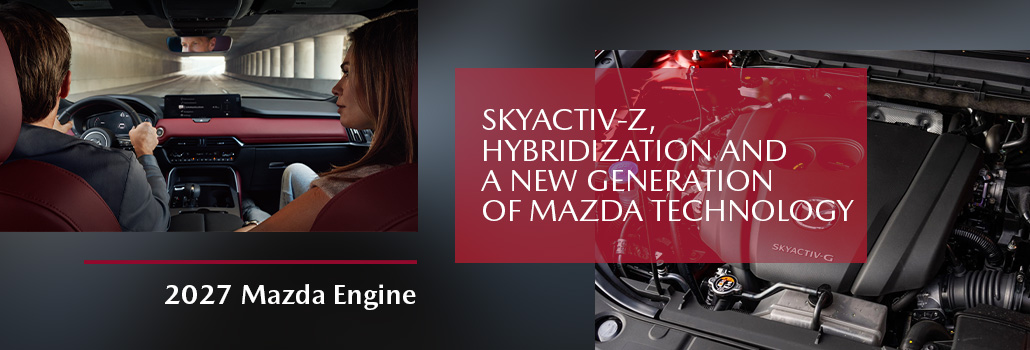
The year 2027 could mark a particularly important step in the evolution of Mazda powertrains. As the automotive industry accelerates its shift toward electrification, Mazda continues to follow its own strategy: improving the internal combustion engine while integrating it more closely with electric technologies.
At the heart of this evolution is a name that is expected to become increasingly important: SKYACTIV-Z. This new Mazda engine, currently under development, is set to become one of the pillars of the lineup in the electrification era. Mazda has confirmed that it will be a 2.5-litre inline four-cylinder gasoline engine and plans to pair it with a new in-house hybrid system. Its introduction is planned during 2027 in the next-generation CX-5.
For drivers in Châteauguay, Montreal’s South Shore and surrounding municipalities, this evolution is particularly interesting. Between daily traffic, highway driving, winter temperatures and the long distances frequently travelled in Quebec, the balance between fuel consumption, range, driving enjoyment and ease of use remains an important factor when choosing a vehicle.
At Solution Mazda in Châteauguay, we are therefore closely following the development of future Mazda technologies to better understand what this new generation of powertrains could bring to Quebec drivers. While waiting for these new technologies to arrive, you can also browse our new Mazda vehicle inventory currently available.
First, an important distinction needs to be made. When we refer to the “2027 Mazda engine,” we are currently talking about a technology Mazda plans to introduce during the 2027 calendar year. That does not necessarily mean every vehicle concerned will be sold in Canada under the “2027 model” designation. The exact timing of Canadian versions, their trim levels and final technical specifications will need to be confirmed later.
What is much more concrete is the existence of SKYACTIV-Z itself. Mazda describes this engine as the next major step in its internal combustion engine development after the SKYACTIV-G and SKYACTIV-X generations.
The SKYACTIV-Z currently announced is a 2.5-litre gasoline four-cylinder engine. Mazda wants it to achieve high thermal efficiency across a much broader operating range, rather than being extremely efficient only under a few precise engine-speed and load conditions.
This difference is fundamental. In everyday driving, an engine almost never operates at a perfectly constant speed or load. It has to accelerate, slow down, respond from low speeds, operate when cold and deal with different levels of demand. To meaningfully reduce fuel consumption, the engine therefore needs to be efficient in as many of these situations as possible.
For several engine generations, Mazda has been working around one central idea: before completely replacing the combustion engine, there is still considerable room to improve how the energy contained in fuel is used.
A significant portion of the energy produced by a conventional engine is lost through heat, friction and exhaust gases. The objective behind SKYACTIV-Z development is therefore to convert a greater proportion of that energy into work that actually moves the vehicle.
Mazda notably refers to improvements in several fundamental combustion factors: the air-fuel ratio, compression ratio, combustion duration and timing, heat loss through the cylinder walls, pumping losses and mechanical losses. The manufacturer is also working on new thermal-insulation technology designed to reduce the amount of heat lost inside the engine.
The idea is relatively simple to understand even though achieving it is extremely complex: the more combustion energy can be converted into mechanical work, and the less of it is unnecessarily dissipated as heat, the better the energy efficiency can become.
For Mazda, SKYACTIV-Z therefore represents what the company considers a new step toward its concept of the “ideal” combustion engine.
To understand SKYACTIV-Z, it is useful to look back at SKYACTIV-X and SPCCI, or Spark Controlled Compression Ignition.
In a traditional gasoline engine, a spark plug creates a spark that initiates combustion of the air-fuel mixture. A diesel engine instead uses very high compression to trigger self-ignition of the fuel.
With SKYACTIV-X, Mazda sought to combine certain qualities of these two principles. SPCCI still uses a spark plug, but the spark helps control compression ignition under certain conditions. Mazda succeeded in commercializing this principle to operate with mixtures containing proportionally more air and less fuel.
SKYACTIV-Z is intended to take that development further. Mazda notably plans to expand the operating range in which this type of combustion can be used efficiently.
This brings us to the term “lambda,” which is often used when discussing the future engine.
A lambda value of 1 corresponds to the stoichiometric air-fuel ratio. In other words, the available amount of air theoretically corresponds to the amount required to burn the fuel in the correct chemical proportions.
“Lean” combustion is different: it uses excess air compared with that proportion, meaning a lambda value greater than 1.
It is therefore important not to say that “lambda 1” simply means “very lean combustion.” The two concepts are not synonymous. Mazda’s development strategy instead relies on different methods of combustion control, including SPCCI, lean combustion and very precise air-fuel ratio management, to increase efficiency across a much wider range of conditions.
This nuance is important because it illustrates the complexity of SKYACTIV-Z: progress does not depend on a single miracle technology, but on the combination and extremely precise control of several combustion phenomena.

Possibly the most important aspect of SKYACTIV-Z is that it should not be viewed as an isolated combustion engine.
Mazda has confirmed that the engine will be paired with a hybrid system developed by Mazda when it is introduced in the CX-5 during 2027.
This approach differs from that of the current Mazda CX-50 Hybrid, whose hybrid system is based on technology sourced from Toyota. With the future CX-5, Mazda is preparing its own engine-electrification package.
However, we do not yet know all the specifications consumers naturally want to see. Combined horsepower, torque, battery capacity, electric motor output and Canadian fuel-consumption ratings have not all been officially specified yet.
It would therefore be premature to publish figures.
The technical philosophy is much clearer, however. The combustion engine and electric system are intended to work together so that each can operate where it is most efficient.
An electric motor can be especially advantageous during starts and rapid speed changes, while a highly efficient combustion engine can retain several advantages on longer trips. Integrating the two also makes it possible to recover some energy during deceleration.
Mazda therefore wants to improve the efficiency of the combustion engine itself while taking greater advantage of electrification. For drivers who want to compare this approach with Mazda vehicles currently on the market, a test drive at Solution Mazda already provides an opportunity to experience the different powertrains available today.
This combination could be particularly relevant in a region such as Châteauguay and Montreal’s South Shore.
A driver may, for example, make short urban trips in Châteauguay or Mercier during the week, regularly cross into Montreal and use the highway to travel toward Beauharnois, Saint-Constant, Candiac or other parts of the Montérégie.
The vehicle therefore has to operate efficiently in very different environments.
Quebec winters also need to be considered. Cabin heating, cold starts, winter tires and road conditions can all influence energy consumption.
In this context, a hybrid system does not require the driver to manage external charging every day as a plug-in vehicle would. The vehicle manages the interaction between its energy sources itself.
That does not mean one technology is automatically superior to all others. A hybrid, plug-in hybrid and fully electric vehicle each meet different needs. That is precisely why Mazda continues to pursue a strategy based on several technological solutions rather than an immediate shift to a single mechanical architecture.
When a new vehicle reaches the market, everyday use also remains one of the best ways to determine whether a powertrain genuinely meets your needs. Drivers in Châteauguay and the surrounding area can book a Mazda test drive to compare models currently available.
The model to watch first is clearly the Mazda CX-5.
The new generation of the CX-5 began its rollout before the arrival of SKYACTIV-Z. Mazda planned a gradual introduction of the model across different markets, while the addition of the SKYACTIV-Z powertrain and Mazda’s new hybrid system is expected during 2027.
This timeline helps explain why the CX-5 represents such an important step.
Instead of developing a new vehicle, a new engine and new hybrid technology all at once, Mazda can evolve its platform progressively.
For consumers looking for a future Mazda CX-5 Hybrid, the SKYACTIV-Z system could therefore represent one of the model’s most significant mechanical developments in several years.
Once again, Canadian specifications will need to be confirmed before drawing conclusions about performance or fuel consumption.
Buyers already considering a CX-5 or another Mazda SUV can browse the new Mazda models available in Châteauguay to compare the trims and powertrains currently offered.
The CX-5 will be the first model announced with this technology, but SKYACTIV-Z development extends beyond this single vehicle.
Mazda plans to use knowledge gained from this new generation of combustion to improve its inline-six engines as well. These engines are associated with Mazda’s large-vehicle architecture, which includes models such as the CX-70 and CX-90 in our market.
That does not necessarily mean a four-cylinder SKYACTIV-Z engine will be installed in all of these vehicles. The idea is instead to transfer certain combustion technologies and development methods created through the project.
Mazda also indicates that this work could contribute to future development of the rotary engine, particularly when it comes to meeting emissions standards.
For Mazda technology enthusiasts, SKYACTIV-Z is therefore interesting not only as a new engine, but also as a technology laboratory that could influence several other powertrains.

For many years, the automotive debate was often framed as a choice between the gasoline engine and the electric vehicle.
Mazda’s strategy is more nuanced.
The manufacturer continues to invest in improving combustion engines while developing hybrids, plug-in hybrids and fully electric vehicles. Mazda already markets several forms of electrification and considers the current period a transition during which needs can vary considerably from one region to another.
SKYACTIV-Z illustrates this philosophy particularly well.
Rather than viewing electrification as a mandatory replacement for the combustion engine, Mazda wants to use the electric motor to help the gasoline engine operate more often in its most efficient zones.
You could therefore describe it as electrification integrated with combustion, rather than two technologies developed independently.
For a manufacturer whose identity has long been built around driving enjoyment and the Jinba-Ittai concept, the way the combustion engine, electric motor, transmission and chassis respond together will likely remain just as important as fuel consumption itself.
That is obviously one of the major questions.
Everything indicates that improving energy efficiency is a major objective of SKYACTIV-Z. Mazda refers to high thermal efficiency across a broad operating range and increased synergy with electrification.
However, no official Canadian fuel-consumption rating should be invented at this stage.
Real-world efficiency will depend on the vehicle, its weight, aerodynamics, transmission, drivetrain, hybrid-system calibration and many other factors.
The right way to approach SKYACTIV-Z is therefore not to promise a specific fuel-consumption figure today in litres per 100 kilometres.
What we can say is that Mazda is trying to improve both combustion-engine efficiency and its integration with electrification. It is this combination that could produce the most significant gain in real-world driving.
For buyers already evaluating the monthly cost of a future Mazda vehicle, it is also possible to explore the different auto financing solutions at Solution Mazda. Choosing a powertrain does not depend solely on fuel consumption: purchase price, monthly payments, annual use and planned ownership period should also be taken into account.

For drivers in Châteauguay, Mercier, Léry, Beauharnois, Saint-Constant, Candiac, La Prairie and across Montreal’s South Shore, the next few years should therefore be particularly interesting.
The automotive transition will probably not amount to a sudden switch from gasoline to electric. Between optimized combustion vehicles, hybrid systems, plug-in hybrids and fully electric models, consumers will have several ways to reduce fuel use or emissions depending on their habits.
The future Mazda SKYACTIV-Z engine is particularly representative of this evolution.
It preserves the internal combustion engine, but evolves it to operate as one component of a much more integrated powertrain.
At Solution Mazda in Châteauguay, we will continue to follow announcements surrounding future Mazda models and the arrival of SKYACTIV-Z in Canada. Once horsepower, fuel-consumption ratings, Canadian trims and launch dates are officially confirmed, it will then be possible to compare this new technology directly with the Mazda powertrains currently offered.
Drivers who would like to discuss their next vehicle can also contact the Solution Mazda team for information tailored to their needs.
Mazda is currently developing SKYACTIV-Z, a 2.5-litre inline four-cylinder gasoline engine. The manufacturer plans to pair it with its own hybrid system and introduce it in the CX-5 during 2027.
Mazda has confirmed that a CX-5 using SKYACTIV-Z and a Mazda-developed hybrid system is scheduled to be introduced during 2027. However, it is important to distinguish the year the technology is introduced from the Canadian commercial model year. Precise details regarding the versions offered in Canada still need to be confirmed.
The SKYACTIV-Z currently announced by Mazda is a 2.5-litre inline four-cylinder engine. Mazda plans to build on an existing architecture while introducing major developments in combustion and thermal management.
Mazda has not yet released all the final specifications needed to state with certainty the output of the version intended for the Canadian market. It is therefore preferable not to provide a figure at this time. The stated objective is to combine energy efficiency, compliance with stricter emissions standards and driving enjoyment.
Mazda presents SKYACTIV-Z as the next major step in its combustion-engine strategy and plans to gradually simplify its mechanical architectures. However, the transition does not necessarily mean that every existing SKYACTIV-G engine will disappear at the same time in every market or every model.
No. Mazda’s current strategy instead relies on several solutions offered in parallel. The manufacturer continues to develop more efficient combustion engines, hybrid and plug-in hybrid vehicles, as well as battery-electric vehicles. The goal is to gradually adapt technologies to markets, infrastructure and consumer needs.
Mazda plans to introduce SKYACTIV-Z with its new hybrid system in the CX-5 during 2027. The precise timing for this powertrain to reach Canadian dealerships still needs to be confirmed.
People who want to stay informed about future models can contact Solution Mazda in Châteauguay. When a model matching their criteria is available, they can also book a test drive.
Yes. Drivers considering replacing their current vehicle can already begin preparing for a future purchase. Solution Mazda makes it possible to request a trade-in appraisal, which can help provide a better understanding of its value toward the eventual purchase of a new Mazda vehicle.
The arrival of SKYACTIV-Z shows that, for Mazda, the future of the combustion engine and the future of electrification can progress together.
More precise combustion, improved heat management, continued development of SPCCI and the integration of a Mazda-developed hybrid system could profoundly transform the role of the gasoline engine in the brand’s future vehicles.
Several unknowns remain, including final output, Canadian fuel-consumption ratings, the exact configuration of the hybrid system and the precise launch schedule in Quebec.
But one thing is now much clearer: the 2027 Mazda engine will not simply be a new version of an existing gasoline engine. With SKYACTIV-Z, Mazda is preparing an architecture designed from the outset to work with electrification and serve as a technological foundation for several future developments.
For drivers in Châteauguay and Montreal’s South Shore who want to follow the evolution of Mazda vehicles, SKYACTIV-Z will therefore be one of the most interesting automotive technologies to watch. While waiting for upcoming announcements, you can discover the new Mazda vehicles available at Solution Mazda, book a test drive or contact our team to discuss your next vehicle.